Every day, somewhere in the country, a message about risk is being sent. A weather alert from the Maldives Meteorological Service. A health update from the Ministry of Health or Health Protection Ageny. A road safety post from the Maldives Police Service. A warning shared in a Viber group, a neighbors WhatsApp message, a council announcement on Facebook. We live inside a constant flow of risk information and how we receive it, understand it, and act on it shapes how safe our communities are.
A 2024 study by the National Disaster Management Authority (NDMA), published under the Climate Risk and Early Warning Systems (CREWS) initiative with support from the United Nations Office for Disaster Risk Reduction (UNDRR), examined exactly this question: how does risk communication actually work in the Maldives, and what shapes the way people respond to it?
What risk communication actually means
Risk communication is the exchange of information, advice, and opinions between experts or officials and the people facing a hazard. The point is not to scare people, and not just to inform them. It is to give communities what they need to make informed decisions about their own health, safety, and environment.
Done well, risk communication shapes how people perceive a threat, how seriously they take it, and what they choose to do about it. Done poorly, it can lead to people ignoring warnings, misunderstanding instructions, or feeling that the information doesn't apply to them. Effective risk communication is the bridge between an early warning being issued and a household actually preparing for what's coming.
The hazards we worry about and the ones we don't
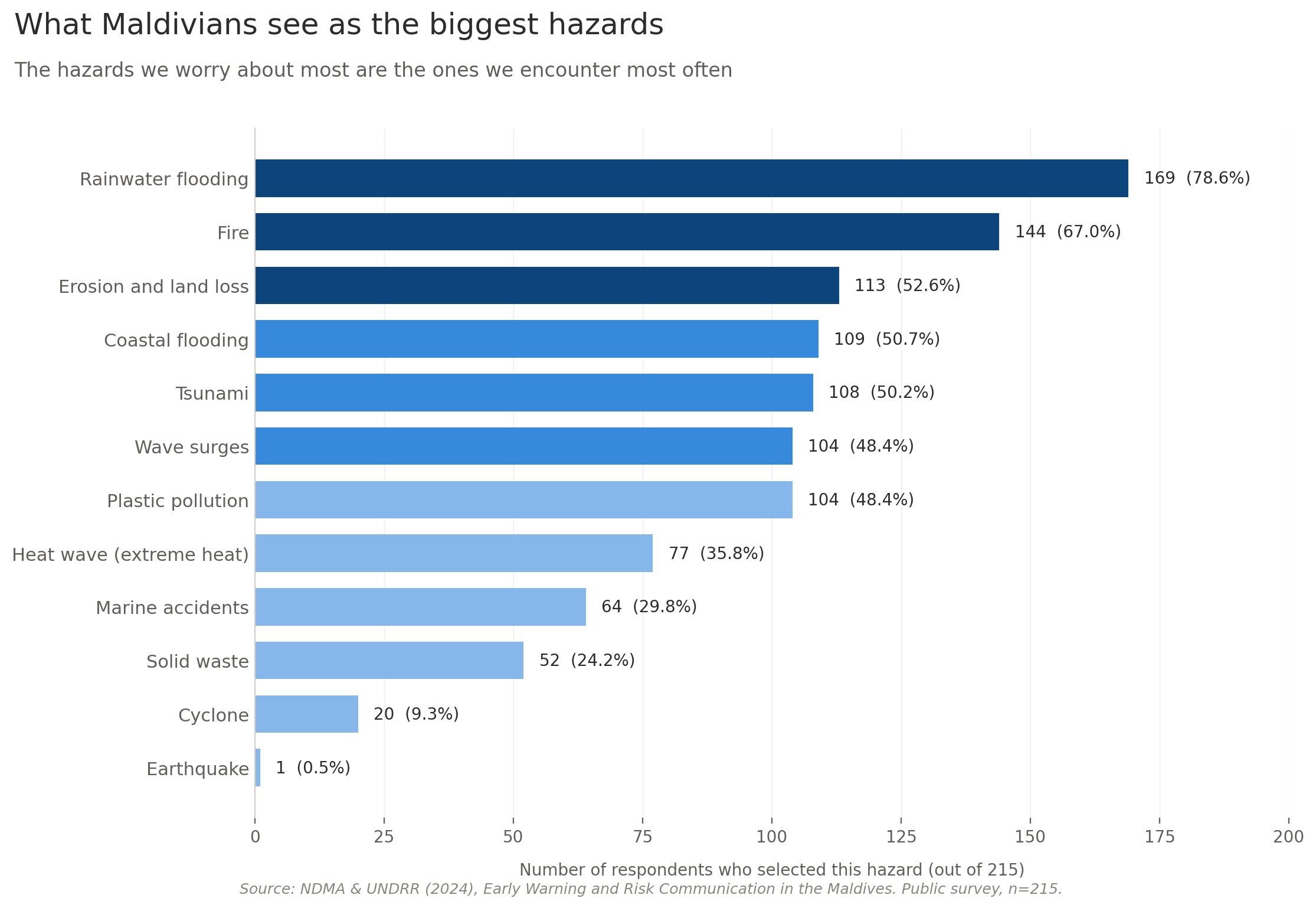
One of the report's most striking findings comes from how Maldivians actually rank the hazards facing their communities.
When asked, the public identified rainwater flooding (78.6%), fire (67%), and coastal flooding (50.7%) as the most significant risks. Tsunami still ranked high (50.2%) — a reflection of how deeply the 2004 disaster shaped national memory.
But the bigger pattern is that the hazards people worry about most are the ones they encounter most often. Floods and fires happen frequently across the country, with moderate to significant impact each time. Tsunamis and tropical cyclones, although potentially catastrophic, occur rarely sometimes with intervals longer than a person's lifetime.
This shapes a particular kind of vulnerability. Communities are well-attuned to the hazards they see regularly, but may underestimate the rare ones, even when those rare events are the most devastating when they do occur. Closing that gap is one of the central challenges of risk communication in the Maldives.
Who's communicating risk in the Maldives
Risk communication isn't done by one agency. It's a shared responsibility, with different institutions covering different kinds of risk.
NDMA uses social media platforms to share information about the wide range of hazards affecting the Maldives.
The Ministry of Health and Health Protection Agencyfocuses on public health risks and disease outbreaks.
The Maldives Police Service communicates around crime prevention and road traffic safety.
Maldives Meteorological Service is the nodal agency for weather and natural hazard alerts.
The 2024 study found that all responding agencies use a combination of social media and traditional media to reach the public. Social media is particularly effective in a country where internet penetration reached 83.9% in 2024, but the study also flagged a real concern. Digital reach is not the same as inclusive reach. Digital literacy and access vary across the population, and marginalized or vulnerable communities may not be reached through online channels alone.
A risk message that travels through five social media platforms but doesn't reach an elderly person living alone, a person with a disability, or a household without internet access has not done its full job.
Why we perceive risk differently
This is one of the most important and under appreciated findings in the report. Risk perception is subjective. Two people facing the same hazard can perceive it completely differently, and both responses can be entirely rational from their own perspective.
How a person perceives risk shapes how they respond to it. If someone doesn't believe a hazard applies to them, they won't act on a warning, no matter how clear or how well-targeted. This is why risk communication is not just about issuing warnings. It's about understanding the people receiving them.
The report identifies a number of cross-cutting factors that influence how Maldivians perceive risk:
Trust in institutions — do people believe the agencies issuing the warning?
Limited technical knowledge — do they understand what the warning actually means?
Acceptance of risk as a norm — has frequent exposure made the hazard feel routine?
Absence of emergency plans — do households know what to do?
Belief that disasters are inevitable acts of divine fate — does the framing reduce the sense that personal action matters?
None of these factors are flaws in the public. They are the realities risk communication must work with.
The factors that shape how we respond
The report breaks down the contextual factors influencing risk perception into six categories. Understanding these helps explain why two communities can receive the same warning and respond very differently.
These factors don't operate in isolation. A risk message lands at the intersection of all six.
Why understanding risk communication matters
Risk communication is often treated as something that happens to us. A notification that arrives, a forecast that scrolls past, an alert we glance at and put down. The 2024 study reframes it as something we participate in.
We are not just passive receivers of risk information. We are part of the system that makes it work. How we interpret a warning, what we choose to do with it, who we share it with, and whether we trust the institution issuing it — all of this shapes whether the system actually keeps our communities safe.
The report's most important insight may be the simplest one. Risk communication is not a one-way broadcast. It is a shared conversation between institutions and the people they serve. And like any conversation, it works best when both sides are listening.
Read the full report